Every Step Down: What the 4K Scan Actually Reveals in Jacob's Ladder's Last Ten Minutes
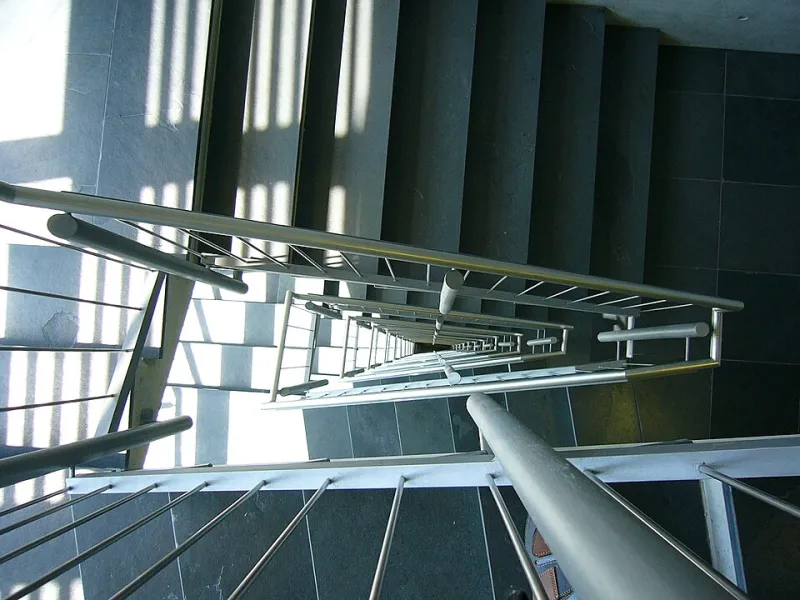
Photo: User:Mattes, Public domain, via Wikimedia Commons
We've all heard the ending called a cheat. Jacob Singer (Tim Robbins) is bleeding out on a gurney in a field hospital in Vietnam while his son Gabe waits at the top of a staircase made of light, and the whole movie folds backward into a single fact: the man we were following was never walking out of that jungle. The 4K restoration doesn't overturn that reading, and it doesn't try to. What it does is slow the last ten minutes down enough that you can actually watch the film decide.
That's the gift of a careful high-resolution transfer. Not answers — elbow room.
The Staircase Was Always There
Go back to the first act. The apartment building's stairwell, the one Jake climbs with groceries and dread, has a specific personality: chipped paint, a handrail worn smooth, a bulb that never quite commits to being on. In the new scan that paint reads as a dirty mustard, and — this is the part that got me — it's the same mustard as the light at the top of the final staircase.
On a muddy VHS dub, that connection is invisible. Even a decent Blu-ray flattens the two spaces into 'grimy interior' and 'glowy afterlife.' At 2160p with a proper HDR pass, the two staircases rhyme, and the rhyme makes a point: Jake has been climbing toward that landing since the opening credits. The film wasn't hiding the ending from us. It was rehearsing it.
Louis, the Demons, and the Frame That Cracked
Danny Aiello's chiropractor scene is the movie's thesis statement, and the 4K version lets you see how physically cramped it is. The camera crowds Jake against the wall, the ceiling fan chops the tungsten light into pieces, and Aiello's sweat is suddenly very legible. That claustrophobia matters because Louis is describing a paradox — that the things tearing you apart might be angels pulling you free — while the frame itself seems to be squeezing the air out of the room.
Resolution is not always flattering. Here it's clarifying. The scene reads less like a monologue and more like a man being told, gently, how to die.
A Hospital With No Medicine in It
The gurney sequence is where the restoration earns its keep. Previous home video versions smeared the overhead fluorescents into a general haze; the 4K transfer keeps them hard and separate, so you can count the tubes and see how little they illuminate. The room feels less like a hospital than a set dressing of one — which is exactly the uncanny note the scene needs. Nothing in that room functions. Not the lights, not the equipment, not the doctors. It's a place built to look like care and deliver none.
And the crowd noise. Listen to how it sits under the dialogue. In the higher-resolution audio presentation, the murmuring around Jake reads as indecipherable rather than merely quiet — a room full of voices that aren't for him.
Grain Is the Ghost
Here's where I'll get into trouble with the purists, so let me hedge: this is an impression, not a lab report. Watching the final ascent, the grain never disappears, and it shouldn't. The restoration team clearly chose to protect the film's texture rather than scrub it into digital plastic, which is the single most important decision any 4K catalog release makes. But the grain does seem to behave differently as Jake climbs — it thins toward the top of the stairs, opens up, gets quieter.
Could be the optical printing. Could be the light. Could be that I've watched this movie too many times to be trusted. Either way, the effect is emotional: the image itself seems to be letting go of its own density as the character lets go of his.
Warm, Cold, and the Palette That Splits a Man
Adrian Lyne and cinematographer Frederick Elmes built the film on a simple temperature war. Warm is family, Jezzie, the bathwater, the apartment. Cold is the subway, the government men, the corridors, the fluorescent dread. The 4K grade doesn't invent that split; it sharpens the border between the two so you can feel the movie flipping sides.
Which makes the final staircase interesting. It's neither. It's warm light reached through a cold hallway. The palette doesn't resolve into comfort — it just stops arguing.
What Ambiguity Costs at 2160p
A bad restoration answers questions nobody asked. A good one hands you better questions. The 4K version of Jacob's Ladder leaves the central ambiguity exactly where it belongs, but it hands you the tools to see how deliberately that ambiguity was constructed: the repeated stairwell, the room that only resembles a room, the grain that loosens as the light comes up.
So no, the scan doesn't tell you whether the whole film was a dying man's last thought or a dying man's last thought being gently interrupted. It tells you that Lyne and Elmes staged the answer with the patience of people who knew we'd eventually be looking this closely. Nearly four decades on, we finally are.